

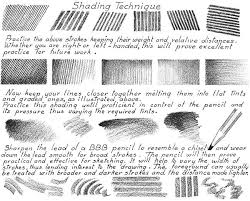
encil shading techniques create depth and realism by manipulating stroke patterns and pencil pressure. Key methods include hatching (parallel lines), cross-hatching (intersecting lines), circulism (overlapping circles), and contour shading (lines that follow the object’s curves). Mastering pressure and utilizing different pencil grades (\(HB\) to \(6B\)) unlocks the full value scale Understanding how to apply graphite is the foundation of realistic drawing:
Stippling: Building up shadows using countless tiny dots. The denser the dots, the darker the area
Hatching: Drawing a series of parallel lines close together. The closer the lines, the darker the shadow.
Cross-Hatching: Layering sets of parallel lines at intersecting angles (\(45^{\circ }\), \(90^{\circ }\), etc.) to create a dense mesh for deep shadows.
Circulism: Using continuous, overlapping circular strokes. This is excellent for creating soft textures like skin or clouds.
Contour Shading: Applying lines that curve and wrap around the shape of the object, which helps define its 3D volume.
Blending: Using a blending stump, tortillon, or a very light touch with your pencil to smooth out harsh lines and create gradual, even transitions.
